Home
» Acne skin care
»
Why Acne Can Get Worse After Starting a New Skincare Routine
Why Acne Can Get Worse After Starting a New Skincare Routine
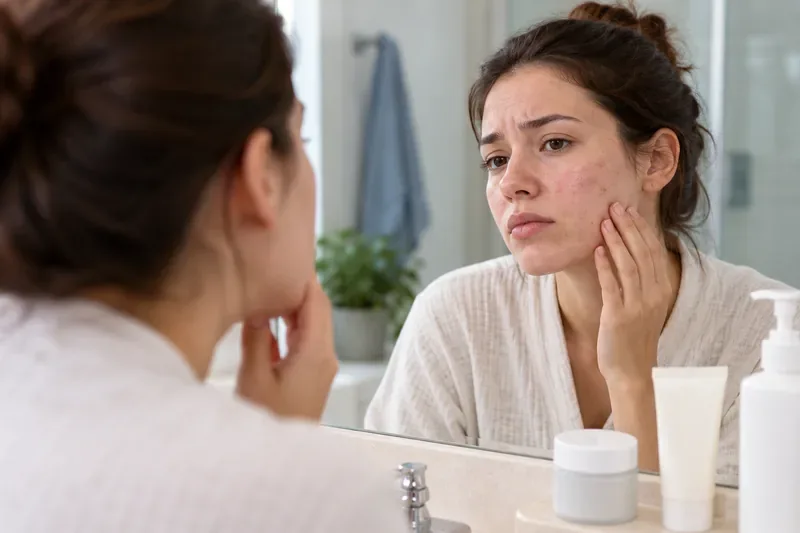
Starting a new skincare routine is supposed to make skin better, so a sudden crop of bumps, redness, or painful pimples can feel like proof that something has gone wrong. Sometimes it has. Other times, the timing is misleading: acne can continue to form for weeks after treatment begins, while certain active ingredients can also irritate the skin enough to make breakouts look more inflamed.
The useful first step is not to decide that every worsening is “purging.” That popular term is not a precise medical diagnosis. A better approach is to look at what changed, where the new lesions are appearing, whether the skin is itchy or burning, and whether the routine contains proven acne treatments such as a topical retinoid, benzoyl peroxide, salicylic acid, or azelaic acid. The American Academy of Dermatology (AAD) includes these among recommended topical options in its current acne guidance, while also emphasizing gentle skin care and realistic treatment timelines. See the AAD acne clinical guideline.
A new routine can coincide with more visible breakouts, but redness, burning, itching, lesion location, and the products added all help distinguish a normal adjustment from irritation or another problem.
What a beginner should know before changing anything
Acne does not respond instantly to most topical treatments. The AAD notes that people may need roughly four to eight weeks to see fewer breakouts, and clearing can take longer. That means new pimples in the first days or weeks do not automatically prove that a treatment is failing. At the same time, repeatedly switching products can itself irritate the skin and make acne harder to judge. Read the AAD guidance on adult acne treatment timelines.
It also helps to separate acne from irritation. Acne lesions may include blackheads, whiteheads, inflamed red bumps, pustules, deeper nodules, or cysts. Irritant or allergic reactions are more likely to involve burning, stinging, marked dryness, itch, swelling, a rash, or blisters. These patterns can overlap, which is why a severe or persistent reaction deserves medical assessment rather than home experimentation.
Why acne can look worse after a new routine
1. The treatment has not had enough time to work
Acne lesions begin developing before they are obvious on the surface. When someone starts a new routine, pre-existing clogged pores can continue turning into visible blemishes. This can create the impression that the new product “caused” every new pimple even when the acne process was already underway.
This is especially relevant with evidence-based acne medicines that work gradually. The AAD recommends topical retinoids, benzoyl peroxide, salicylic acid, azelaic acid, and other therapies depending on the type and severity of acne. A person who changes products after only a few days may never give an appropriate treatment enough time to show whether it helps.
2. Too many active ingredients are irritating the skin
A skincare “active” is an ingredient intended to have a biologic effect, such as adapalene, tretinoin, benzoyl peroxide, salicylic acid, glycolic acid, or another exfoliating acid. Using several at once can increase dryness and inflammation.
The U.S. Food and Drug Administration’s 2026 labeling for over-the-counter adapalene 0.1% plus benzoyl peroxide 2.5% states that redness, itching, dryness, burning, and peeling may occur, especially during the first few weeks and when people use abrasive cleansers, drying products, or more than one topical acne medication at the same time. Review the 2026 FDA-approved label.
NICE, the United Kingdom’s National Institute for Health and Care Excellence, similarly advises reducing irritation from topical retinoids or benzoyl peroxide by starting with alternate-day or short-contact application and increasing only if tolerated. Its acne guideline was last updated on April 30, 2026. See the NICE acne recommendations.
3. A product may be too occlusive or may not suit acne-prone skin
Some moisturizers, sunscreens, cosmetics, hair products, or leave-on treatments can contribute to clogged pores in susceptible people. The AAD advises choosing skin care, sunscreen, and makeup labeled non-comedogenic or oil-free when acne-prone skin is a concern. “Non-comedogenic” means formulated to be less likely to block pores; it does not guarantee that a product will work for every person.
If breakouts appear mostly in areas where a new leave-on product is applied, especially where acne was not previously common, that pattern is useful information. It does not prove the product is the cause, but it is a reason to simplify the routine and reassess.
4. Scrubbing and over-cleansing can make inflammation worse
More cleansing is not necessarily better. The AAD recommends gentle cleansing, usually twice daily and after sweating, rather than repeated washing or abrasive scrubbing. Washcloths, cleansing brushes, gritty scrubs, strong astringents, and frequent exfoliation can damage the skin barrier and intensify redness and tenderness. See the AAD list of skincare habits that can worsen acne.
5. The reaction may be irritation or contact dermatitis rather than acne
Contact dermatitis is inflammation caused by direct irritation or an allergic reaction to something touching the skin. Unlike a typical acne flare, it often produces prominent itching, burning, stinging, swelling, or a rash. Blisters or oozing can occur in more intense reactions.
Fragrance, preservatives, botanical extracts, dyes, and many other ingredients can trigger reactions in susceptible people. Even products marketed as “natural” or “clean” can cause problems. The AAD recommends testing a new skincare product on a small area before broader use when possible. Read the AAD guidance on testing skincare products.
Is “skin purging” always the explanation?
No. “Purging” is widely used online to describe an early increase in visible blemishes after starting a product that changes skin-cell turnover, especially a retinoid. Some acne medications can be associated with an early apparent worsening, but that does not mean every breakout after a new product should be endured.
A practical distinction is to ask whether the new routine contains a recognized acne treatment, whether the breakouts are occurring in usual acne-prone areas, and whether the skin is otherwise tolerating the product. If the main symptoms are intense burning, itching, swelling, widespread rash, cracking, or blistering, irritation or allergy is more concerning than a simple treatment adjustment.
Likewise, a moisturizer, facial oil, makeup product, or fragranced serum does not become beneficial merely because breakouts started soon after it was introduced. A worsening pattern that continues or spreads should prompt reassessment.
How to prepare before starting a new acne routine
Beginners usually get clearer information from a simple routine than from a shelf full of products. Before adding a new acne treatment, write down what you already use and check the active ingredients. This helps prevent accidental duplication, such as using an exfoliating cleanser, an acid toner, a retinoid, and benzoyl peroxide all in the same evening.
Choose a gentle cleanser without abrasive particles.
Use a non-comedogenic moisturizer to support the skin barrier.
Use a broad-spectrum sunscreen as directed, especially when using products that increase sun sensitivity.
Add one major treatment change at a time when practical so reactions are easier to trace.
Photograph the skin in similar lighting once or twice a week rather than checking repeatedly throughout the day.
Record burning, itching, scaling, swelling, and tenderness, not just the number of pimples.
If pregnancy is possible or being planned, do not casually start a topical retinoid. NICE states that topical retinoids are contraindicated during pregnancy and when planning pregnancy. A clinician or pharmacist can help select an alternative.
What to do if acne worsens after starting the routine
Step 1: Check the timing and the exact products added
Look at the previous one to three weeks. Identify every new cleanser, moisturizer, sunscreen, serum, makeup product, hair product, and acne treatment. A reaction is easier to investigate when there is a clear timeline.
Step 2: Look for irritation clues
Redness alone can accompany acne, but burning, stinging, itching, diffuse peeling, swelling, or a rash suggest that the skin barrier may be reacting poorly. The FDA labeling for adapalene-containing products advises stopping use and asking a doctor before restarting if irritation becomes severe.
Step 3: Simplify rather than adding more treatments
When the cause is unclear, adding another acid, spot treatment, scrub, or mask usually makes interpretation harder. A simpler routine with a gentle cleanser, moisturizer, sunscreen, and only the necessary acne treatment is often easier to tolerate and evaluate.
Step 4: Use acne medicine as directed, not more aggressively
Applying extra medication does not make acne clear faster and can increase irritation. The AAD specifically warns that overusing topical acne products can cause dryness, peeling, burning, irritation, and apparent worsening.
Step 5: Reassess after an appropriate interval
If the routine is tolerable and includes an evidence-based acne treatment, improvement may take several weeks. If there is no meaningful improvement after about six to eight weeks, or acne is clearly worsening, a clinician can help decide whether the diagnosis, product choice, application schedule, or treatment strength should change.
Common mistakes that make a new routine harder to judge
Changing several products at once. If the skin reacts, you cannot tell which change mattered.
Using strong actives every day from the first application. Some people tolerate this, but others need a slower start.
Scrubbing flaky skin away. Mechanical friction can worsen irritation.
Skipping moisturizer because the skin is oily. Acne treatments can dry the skin; the AAD notes that an appropriate moisturizer can improve tolerance.
Picking or squeezing new lesions. This increases the risk of prolonged inflammation, scarring, and post-inflammatory hyperpigmentation.
Assuming every reaction is “purging.” Allergy, irritation, product-related clogging, and ordinary acne progression are different possibilities.
When worsening acne deserves medical attention
See a dermatologist or other qualified clinician sooner rather than simply waiting if acne is becoming deeply painful, nodular, or cystic; if scarring is developing; if the reaction is severe; or if the diagnosis is uncertain. The AAD notes that deep nodules and cysts can scar and are best treated with professional help. Review AAD information on acne lesion types.
Stop the suspected product and seek prompt medical care for a severe skin reaction, especially marked facial swelling, hives, widespread blistering, or rapidly worsening pain. Difficulty breathing, wheezing, trouble swallowing, faintness, or other signs of anaphylaxis require emergency care. The FDA lists these as potentially serious allergic reactions to cosmetic ingredients. See the FDA information on cosmetic allergens.
A simple way to judge whether the routine is helping
Instead of expecting perfect skin immediately, track three things: whether new inflammatory lesions are becoming less frequent, whether existing lesions are healing without excessive irritation, and whether the skin barrier feels comfortable enough to continue treatment. Improvement can be gradual.
If redness and discomfort are escalating while acne is unchanged, the routine may be too irritating. If breakouts are appearing in unusual areas after a new leave-on product, the product may deserve suspicion. If acne remains active despite consistent, tolerable treatment for several weeks, professional guidance can prevent months of trial and error.
The key is to avoid treating all early worsening as the same phenomenon. New acne after a skincare change can reflect normal treatment lag, medication irritation, an unsuitable product, excessive exfoliation, contact dermatitis, or simply the natural course of acne. Distinguishing those possibilities by timing and symptoms is safer than pushing through every reaction.