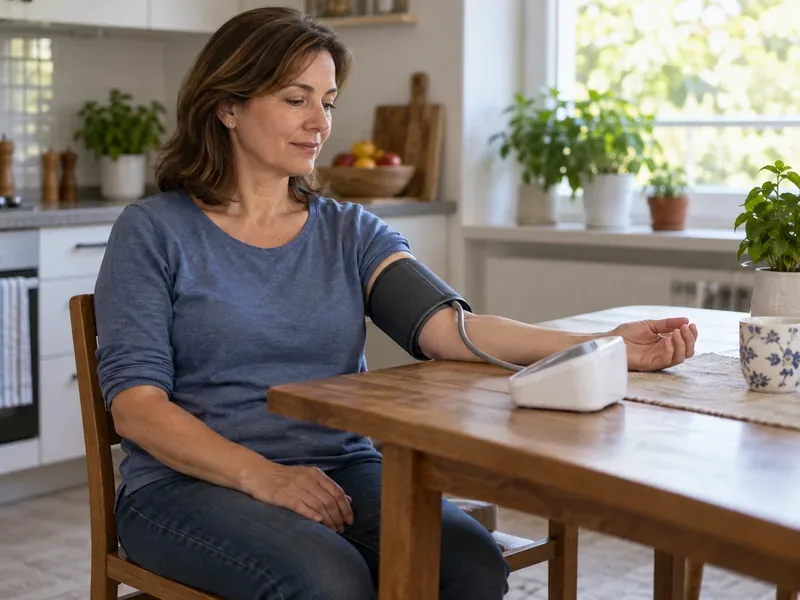
A cuff that fits the arm’s circumference but gaps or pinches on its shape may be hard to position consistently. Use these five steps to check cuff placement on a broad or tapered upper arm. The guide is for adults using an automatic upper-arm home monitor; your monitor’s instructions and care team’s advice take priority.
Prerequisites
- Equipment: Your automatic upper-arm blood pressure monitor, its instructions, and a flexible tape measure.
- Time: About 10 minutes for a first fit check, including five minutes of quiet rest before taking a reading.
- Difficulty: Easy. Ask another person to help measure if needed.
How to check cuff placement
Step 1: Find the cuff’s stated size range
Look for the arm-circumference range printed on the cuff, monitor packaging, or manual. Cuff ranges vary by model and manufacturer, so don’t rely on labels such as “large” alone. The American Heart Association (AHA) advises choosing a monitor with a cuff that fits your measured upper arm; an incorrectly sized cuff can produce an inaccurate reading. A cuff that is too small can read high, while one that is too large can read low. See the AHA’s home-monitoring instructions.
Step 2: Measure the upper arm
Expose the arm without rolling a tight sleeve up around it. Relax the arm at your side, then measure around its midpoint—halfway between the shoulder’s bony point and the elbow. Keep the tape level and snug without compressing the skin. Record the measurement and compare it with the specific cuff’s printed range. If it falls outside that range, get a compatible cuff or a device that covers it; don’t force the cuff to fit.
Step 3: Check whether the cuff shape suits the arm
Wrap the cuff as directed and look for a flat, even fit. A broad upper arm that narrows toward the elbow can leave a wedge-shaped gap with some cuffs, or make one edge dig in while the other feels loose. Don’t compensate by twisting the cuff, pulling it excessively tight, or overlapping it beyond its marked range. Cuff shape can matter on conical arms, and research reviews discuss conical cuffs as an option for some larger, tapered arms. Ask your clinician or pharmacist whether a compatible conical cuff is appropriate for your monitor.
Step 4: Align and secure the cuff
Place the cuff on bare skin, with its lower edge just above the elbow bend. Align the artery marker or tubing according to your device’s illustration; markers differ by model. Wrap it evenly and snugly, without wrinkles or pinching, and use the manual’s fit check. The AHA’s scientific statement describes proper cuff placement on the upper arm and emphasizes using the manufacturer’s sizing range. Read the AHA scientific statement on blood pressure measurement.
Step 5: Take a reading and record the fit issue
Sit with your back supported and feet flat. Rest quietly for five minutes, support the cuffed arm at heart level, and avoid talking during the measurement. Follow your care team’s schedule and device instructions. If the cuff shifts, gaps, pinches, or gives repeated error messages, note what happened and show the monitor and cuff to your care team. A single reading cannot confirm a diagnosis, and you should not change medication based on this fit check.
Troubleshooting
- The size range includes my measurement, but the cuff still gaps or pinches. The cuff may not suit your arm’s taper. Ask the device maker or your care team about a compatible conical or differently shaped cuff, and have them observe your technique.
- My arm is outside the printed range. Don’t use the cuff beyond its range or estimate a reading from a poor fit. Ask about a validated monitor and cuff combination that covers your circumference.
- The cuff slides or the monitor shows an error. Recheck bare-skin placement, alignment, and closure using the manual. Support your arm and remain still. If the problem repeats, bring the device to an appointment for a fit and accuracy check.
Frequently asked questions
Should the cuff be tight on a large upper arm?
It should be secure and evenly wrapped as the device instructions specify, not painfully tight or forced closed. A cuff outside its stated range is the wrong fit even if it fastens.
Can I put the cuff over a shirt?
No. Use bare skin at the cuff site. The AHA recommends placing the cuff directly on the upper arm, with its lower edge above the elbow bend.
When should I ask a clinician for help?
Ask if your arm measurement is outside the cuff range, the cuff cannot lie evenly, readings are repeatedly inconsistent, or you are unsure which cuff is compatible. Seek urgent medical guidance for concerning symptoms or readings as directed by your care team; cuff positioning advice does not replace clinical care.