Home
» Child care tips
»
When Your Toddler Suddenly Refuses Familiar Foods: What Parents Can Do
When Your Toddler Suddenly Refuses Familiar Foods: What Parents Can Do
A toddler who suddenly turns away from a once-favorite food can make an ordinary meal feel worrying. If your child is otherwise acting well, drinking normally, and continuing along their usual growth pattern, a short-lived change in appetite or food preferences is often reasonable to watch calmly. Offer familiar foods again without pressure. A sharp or persistent change, trouble swallowing, signs of dehydration, or a growth concern deserves a call to the child’s pediatrician.
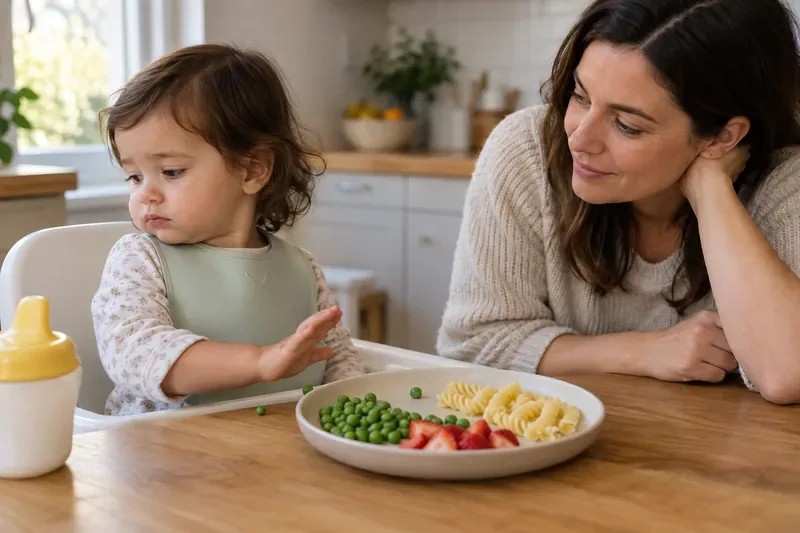
A toddler turns away from peas while a parent stays nearby and keeps the meal calm.
Why can a toddler reject a food they used to eat?
There is no single explanation, and a food refusal by itself cannot tell you what is happening. Common possibilities include a smaller appetite as growth slows after infancy, normal changes in food preferences, a desire for independence, or a temporary disruption in routine. Toddlers may also react to a food’s temperature, texture, smell, appearance, or how it is served. These are possibilities, not a diagnosis.
The American Academy of Pediatrics’ toddler nutrition guidance explains that appetite often falls after the first birthday as growth slows. The CDC’s picky-eating guidance, updated April 14, 2026, notes that toddlers may refuse foods they previously liked. Neither fact proves that a particular child’s change is harmless. Look at the overall pattern: energy, fluids, urination, comfort while eating, and growth over time matter more than one meal or one day.
Choose a response that fits what you are seeing
What you notice
A practical choice
Tradeoff to consider
One or a few meals are smaller; your toddler is active, drinking, and seems well.
Keep the usual meal and snack rhythm, include at least one familiar food, and offer the refused food again another day.
Watching avoids turning a temporary preference into a battle, but it works only when the child remains well and the pattern does not keep narrowing.
Your toddler refuses one preparation, such as cooked peas, but accepts other foods.
Try a small, safe portion in a different form or alongside a familiar food. Let the child look, touch, smell, or taste without requiring a bite.
Changing texture or serving style can reveal a preference, but making a completely separate replacement meal every time can increase pressure on the caregiver and make family meals harder to sustain.
Several foods or food groups are disappearing from the diet, or the change is continuing.
Write down a brief pattern of accepted foods, drinks, symptoms, and timing, and contact the pediatrician for individualized advice.
A short record helps a clinician see a trend; counting every bite can raise stress without answering the medical question.
Your child coughs, chokes, gags repeatedly, seems in pain, or struggles with textures.
Arrange prompt medical advice rather than treating the issue as ordinary pickiness.
Evaluation takes time, but it can identify whether feeding or swallowing support is needed.
Low-pressure strategies: what they help with and what they cannot do
Keep a predictable routine
Offer meals and planned snacks at reasonably consistent times. Water can be available between eating occasions. Large amounts of milk, juice, or frequent grazing may reduce interest in meals, so mention your child’s usual drink intake to the pediatrician if appetite is a concern. Do not sharply restrict a toddler’s fluids or make major diet changes without clinical advice. A routine makes appetite easier to observe, but it will not explain a persistent refusal on its own.
Offer, then let your child decide whether to eat
Put a modest portion of a familiar food beside a small portion of the refused food. Eat together when possible and show, rather than insist, that the food is part of the meal. Your role is to offer safe, suitable food; your child can decide whether and how much to eat. The AAP’s advice for picky eaters supports allowing a child to refuse while continuing to offer a varied meal later. Repeated, relaxed exposure may help familiarity, but there is no guaranteed number of tries or timeline.
Pressure, bargaining for “just one bite,” threats, or using dessert as a reward may get a bite in the moment, but can make meals tense. A neutral response protects the relationship and gives you clearer information about what your child chooses. It does not mean ignoring nutrition or refusing to seek help when warning signs appear.
Change one feature at a time
If the child used to eat sliced banana and now refuses it, try noticing whether the fruit is riper, colder, bruised, or served differently. You might offer a small piece separately rather than mixing it into a preferred food. A small variation makes it easier to learn what the child accepts; disguising or hiding foods can make it harder to know what was eaten and may undermine trust for some children. Keep the presentation age-appropriate and supervise eating. Follow the CDC’s choking-prevention guidance for safe size, shape, texture, and seating.
When is it reasonable to observe, and when should you call?
A brief change is generally less concerning when it affects only some foods, the toddler still eats and drinks across the day, seems comfortable, has usual energy and urination, and has no known change in growth. Continue offering a balanced range over time; a single meal is not a nutrition assessment. At routine visits, ask the clinician to review the child’s growth chart and dietary pattern if you remain unsure.
Contact your pediatrician if the refusal persists, becomes progressively more restrictive, substantially reduces what your child eats or drinks, or comes with pain, frequent vomiting, constipation that is affecting eating, unusual fatigue, or concern about weight gain or growth. Mention any coughing, choking, wet or gurgly breathing after swallowing, food pocketing, very long meals, or difficulty chewing. These signs can warrant assessment; they do not establish a cause. The American Speech-Language-Hearing Association’s clinical guidance describes feeding and swallowing signs that health professionals may evaluate. Your pediatrician can decide whether a feeding or swallowing specialist is appropriate.
Seek urgent medical help if your toddler has difficulty breathing, cannot swallow, becomes unusually hard to wake, or develops sudden swelling of the lips, tongue, or throat. Get prompt advice for signs of dehydration such as markedly fewer wet diapers or trips to urinate, a very dry mouth, or unusual sleepiness—especially if your child is also ill or cannot keep fluids down. Use your local emergency service for severe or rapidly worsening symptoms. The NHS urgent-help guidance for children under five lists warning signs including breathing difficulty, swelling in the mouth, and not urinating for 12 hours; local services and advice lines vary by country.
A useful way to check the pattern
For a few days, note which foods and drinks your child accepts, any symptoms, and whether they seem comfortable at meals.
Record changes in urination, energy, and illness; do not rely on a single meal to judge intake.
Keep the child seated upright and supervised, and prepare foods to reduce choking risk.
Bring the brief notes and your questions to the pediatrician if the change continues or worries you.
There is no need to force a familiar food back onto the menu at the next meal. Calm repetition is a reasonable option for a well child with a broad enough diet; a clinician’s assessment is the better choice when intake is shrinking, symptoms appear, or growth and hydration are in question. This guidance is general and cannot determine the reason for an individual toddler’s food refusal.