Home
» Children's dental care
»
When Should a Child First See a Dentist? What to Expect at the First Visit
When Should a Child First See a Dentist? What to Expect at the First Visit
In the United States, schedule a child’s first dental visit when the first tooth appears, and no later than the first birthday. The American Academy of Pediatric Dentistry (AAPD) recommends establishing a dental home within six months of the first tooth’s eruption and by 12 months of age; the American Dental Association (ADA) gives the same practical timing. The appointment can happen before a child has many teeth, and it does not have to wait until the child can sit alone.
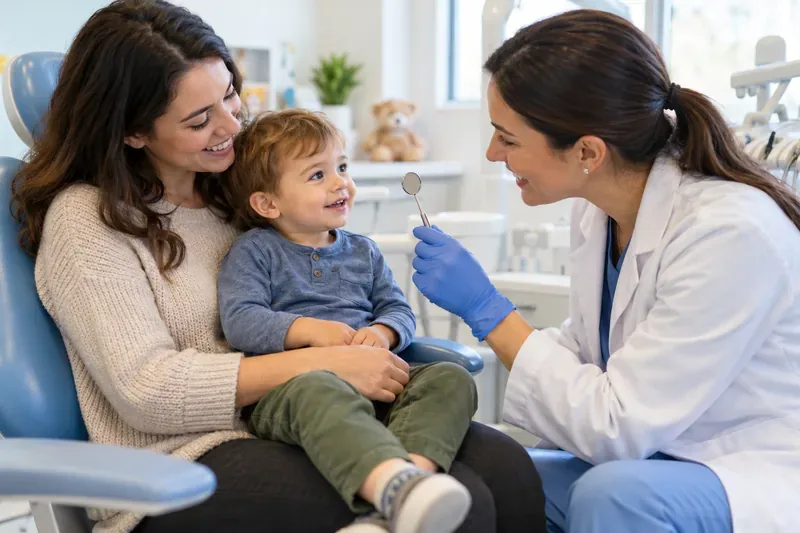
A first appointment may begin with a caregiver holding the child while the dentist introduces a small mirror.
For most babies, this is a preventive visit: the dental team learns about the child’s health and routines, checks the mouth and early teeth, and helps caregivers plan home care. What the dentist does beyond that depends on the child’s age, comfort, findings, and risk for tooth decay. If a child has pain, swelling, or a dental injury, do not wait for the routine age milestone—call a dentist for advice.
When should a child first see a dentist?
Book the visit after the first tooth erupts, or by the child’s first birthday at the latest. AAPD’s 2025 policy on early childhood caries specifies a dental home within six months after the first tooth erupts and no later than 12 months of age. A “dental home” means an ongoing relationship with a dental team that can provide prevention, evaluation, and care as the child grows.
Why start so early? Baby teeth can develop decay soon after they appear. Early visits also give caregivers a chance to ask about brushing, fluoride, feeding, pacifiers, and habits before a problem is obvious. Primary teeth are temporary, but they help children chew and speak and preserve a path for permanent teeth. Action: if your child’s first tooth has appeared, contact a pediatric dentist or a family dentist who routinely sees infants and young children; if the first birthday is approaching, schedule now rather than waiting for more teeth.
What usually happens at the first visit?
The first dental visit is not automatically a filling appointment or a long cleaning. It is usually a short introduction and assessment, but the exact sequence varies by office and child. A dentist may:
Ask about the child’s medical and dental history, medicines, feeding and bedtime routines, brushing, fluoride exposure, teething, and pacifier or thumb-sucking habits.
Look at the teeth, gums, tongue, and other mouth tissues; check for visible decay or injury; and consider how the teeth and jaws are developing.
Assess the child’s risk for cavities and discuss prevention, including an age-appropriate brushing routine and the right amount of fluoride toothpaste.
Demonstrate how a caregiver can clean the teeth, and offer tailored advice about drinks, snacks, and oral habits.
Clean the teeth or apply fluoride varnish when appropriate for the child’s needs and the visit.
For a baby or young toddler, the dentist may examine the mouth while the child sits on a caregiver’s lap or reclines across the caregiver’s lap. The ADA describes this lap-based option for children who are not ready to sit alone. Older toddlers may be invited into the dental chair, perhaps with a caregiver nearby. The team may explain or show an instrument before using it, pause when needed, and keep the visit focused on what the child can comfortably manage.
Will the dentist take X-rays or do a full cleaning?
Not necessarily. X-rays are not automatic simply because it is the first visit. The AAPD’s 2025 radiograph guidance says decisions should reflect the clinical findings, health and dental history, caries risk, age, and stage of development. The ADA likewise says X-rays should be taken when they are expected to provide needed diagnostic information. Action: if X-rays are suggested, ask what question the images will answer for your child and whether they can wait until the child is ready, if appropriate.
A cleaning may be offered, but it is not a pass-or-fail test of whether the visit “worked.” For a very young child, the main value may be the mouth exam and coaching for the caregiver. Fluoride varnish may be recommended when risk assessment supports it; it is not something every child necessarily receives at every first visit. Ask what is being recommended, why, and what home-care steps matter most next.
How can you prepare your child and yourself?
Choose an appointment time when your child is usually rested, not right before a nap if that tends to be difficult. Keep the explanation simple and positive: “The dentist will count your teeth and help us keep them healthy.” A child does not need to practice perfectly or promise to cooperate. The ADA notes that a child may sit on a caregiver’s lap and that a little crying or wiggling can be normal in an unfamiliar setting.
Complete forms ahead of time if the office offers them.
Bring a list of medicines, allergies, health conditions, and questions.
Tell the office if your child has sensory, developmental, mobility, or communication needs so the team can plan accommodations.
Ask whether the dentist wants you to bring prior records or information about the child’s drinking water or fluoride exposure.
Bring up brushing, nighttime bottles or nursing, snacks, teething, pacifiers, thumb-sucking, or anything you have noticed about the teeth or gums.
Do not use a dental visit as a threat or promise a specific procedure will not happen. A better reassurance is that the caregiver and dental team will help the child understand each step. If the child cries, the team can adapt the pace; the visit can still provide useful information and a familiar first experience.
Which common concerns are expected, and which need attention?
Situation
What it may mean
Useful next step
No teeth yet and the first birthday is near
Some children get their first tooth later than others.
Follow the age-based recommendation and arrange a visit by the first birthday.
A little fussing, crying, or wiggling at the first appointment
A new room and unfamiliar people can be a lot for a young child.
Tell the dentist what helps your child settle and let the team set a comfortable pace.
Toothache, visible damage, or a dental injury
This is a reason to contact a dentist sooner than the routine checkup.
Call the dental office promptly for instructions and timing.
Facial swelling, fever with mouth pain, or worsening symptoms
These signs need prompt professional assessment.
Contact a dentist or medical professional the same day; seek emergency care for breathing or swallowing difficulty.
Teething can come with drooling, fussiness, or temporary changes in sleep. The ADA cautions that fever, rash, and diarrhea are not normal teething symptoms. Action: if those occur, or your child seems unusually unwell, contact the child’s pediatrician rather than assuming teething explains it.
For a knocked-out permanent tooth, significant bleeding, a serious facial injury, or swelling that affects breathing or swallowing, seek urgent care. The ADA advises prompt dental or emergency-room care for dental emergencies. If you are unsure how urgent a symptom is, call the child’s dentist or pediatrician and describe exactly what happened.
How often will a child need checkups?
Many families hear “every six months,” but the right interval can depend on the child’s risk, development, and findings. AAPD recommends individualized preventive care, and its parent FAQ notes that a dentist can set visit frequency based on personal oral health. The dentist may recommend a shorter interval for a child who needs closer monitoring or preventive support. Action: before leaving, ask when the next visit should be and which signs should prompt an earlier call.
Quick first-visit checklist
Schedule after the first tooth appears, no later than age 1.
Choose a time when your child is usually rested.
Bring health and medication details, plus questions.
Expect an exam and prevention discussion; cleaning, fluoride, and X-rays depend on the child.
Call sooner for pain, injury, or swelling; seek emergency help if breathing or swallowing is affected.
The goal of a first dental visit is a starting point: a clear picture of the child’s mouth, practical advice for home care, and a plan that fits the child. If an appointment feels different from what you expected, ask the dentist to explain how each recommended step relates to your child’s needs.