Home
» Image analysation
»
Why Two Radiology Reports Can Describe the Same Finding Differently
Why Two Radiology Reports Can Describe the Same Finding Differently
Two radiology reports can describe the same area differently because reports combine image interpretation, clinical context, technical details, and each radiologist’s way of summarizing what matters. Different wording alone does not prove that a finding has changed or that one report is wrong. A meaningful difference in the finding’s location, size, level of concern, or recommended next step does deserve clarification with the clinician who ordered the exam.
Radiology reports are written primarily for health professionals, so technical terms may sound more alarming or more definitive than intended when read without context. The current patient guidance on discussing report results, last reviewed July 1, 2026, advises patients to avoid assumptions and review the findings, impression, and next steps with their doctor. This article explains common reasons for variation and practical options; it cannot determine what a particular image shows or diagnose a reader.
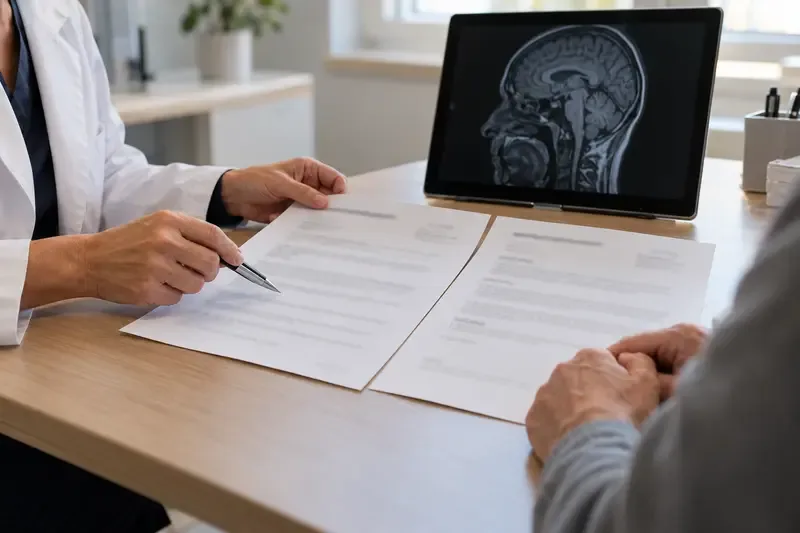
A clinician and patient review two reports alongside an MRI image; the wording needs to be interpreted in clinical context.
What can differ, even when the reports refer to the same finding?
1. The reports may use different levels of detail
The “findings” section describes what the radiologist sees. The “impression” summarizes the most important points and may include possible explanations or a recommendation. One report may describe the visible appearance in more detail, while another uses a shorter phrase in the impression. A shorter summary is not automatically evidence that the finding disappeared; the question is whether both reports refer to the same place and reach the same practical conclusion.
Reporting style also varies. RadiologyInfo notes that some radiologists write findings in paragraphs, while others list structures line by line. In selected fields, the American College of Radiology (ACR) uses Reporting and Data Systems (RADS) to standardize terminology and assessment categories. Those systems help improve consistency in the areas they cover; they do not create one universal vocabulary for every body part, modality, or clinical question.
2. The scans may not be directly comparable
Reports can sound different because the exams were not identical. They may have been taken on different dates, with different imaging methods, body positioning, views, contrast protocols, or image quality. A finding can also be described differently when the earlier images were unavailable to the radiologist. The report’s “comparison” or “priors” section may list earlier studies that were reviewed. If it says no comparison was available, that is useful context to share with the clinician.
RadiologyInfo recommends providing prior imaging from other facilities when possible, since direct comparison can help the radiologist. A PDF report alone does not let a new reader inspect the original images. If the distinction matters, ask the imaging facility how to obtain the complete image files and both reports, then ask whether a radiologist can compare them.
3. A finding may be borderline or uncertain
Images do not always support a single precise label. A report may say “possible,” “probably,” “indeterminate,” or “cannot exclude” when the appearance is not conclusive. Two qualified readers can emphasize different possibilities, especially when a feature is subtle or when a scan has limits. A difference in wording can therefore reflect uncertainty rather than a clear change in the underlying anatomy.
Do not translate a single adjective into a personal risk estimate. “Lesion,” for example, is a broad descriptive term; it does not, by itself, identify a cause. The full report, the reason for the exam, prior images, symptoms, and any recommended follow-up all matter. Ask the ordering clinician what the wording means for the specific decision in front of you.
4. The clinical question or report status may differ
The ordering clinician provides the reason for the scan and relevant history. A report focused on one question may highlight a different detail from a later exam ordered for another reason. Also check whether each document is marked preliminary, final, corrected, or addended. An early interpretation may be updated after review or after additional information becomes available. Compare the latest signed version before treating two versions as competing conclusions.
How to decide what to do next
Start with the practical question: does the difference change the recommended care? Compare the exam date, body part and side, imaging type, “comparison” section, “impression,” and follow-up recommendation. If only descriptive wording changes while the impression and plan remain the same, ask the ordering clinician to explain whether the difference matters. If the impression or recommendation conflicts, ask for a reconciliation rather than choosing the more reassuring or more alarming phrase yourself.
Option
Best fit
Trade-off
Discuss both reports with the ordering clinician
You need to know how the wording relates to your symptoms, history, or treatment plan.
Often the most efficient first step, but the clinician may need to consult the radiologist for image-level questions.
Ask the original imaging facility for clarification or a radiologist review
The reports disagree about a specific feature, or the prior images may not have been available.
Targets the images and report wording directly; availability and turnaround vary by facility.
Request a second opinion from a relevant radiologist or specialist
The finding may substantially affect a major decision, or uncertainty remains after the first discussion.
Can provide another expert review, but may take time, require records transfer, or involve cost; it may not remove uncertainty.
Have another imaging test
Your clinician explains what unresolved clinical question a new test would answer.
May add useful information, but it can also mean cost, delay, contrast considerations, or radiation exposure for tests that use X-rays.
For a second opinion, gather the actual image files, not only screenshots, along with both reports, the exam dates, and the question your clinician wants answered. RadiologyInfo explains that sharing images can support specialist referrals and second opinions and can help doctors compare with previous studies. Keep copies securely and use the facilities’ approved transfer process.
Repeating a scan is not automatically the best way to settle a wording difference. The right test depends on what needs to be answered and which method can answer it. X-rays and CT use ionizing radiation, while MRI and ultrasound do not; the risks and benefits differ by exam. The current RadiologyInfo guidance on medical radiation recommends discussing what a proposed exam is expected to clarify and whether the result will affect care. Ask your clinician why another test is needed, whether existing images can first be reviewed, and whether another modality is suitable.
When is a difference a reason to contact someone promptly?
Contact the ordering clinician or imaging facility promptly if either report calls a finding “urgent” or “critical,” says immediate communication is needed, recommends prompt follow-up, or gives a time-sensitive next step that has not been arranged. The ACR’s practice parameter for communication of diagnostic imaging findings addresses nonroutine communication as well as the written report. If you cannot reach the ordering clinician, call the facility that performed the scan and explain the wording and dates. Do not wait for a routine appointment to clarify an explicitly urgent instruction.
Also ask the facility to check the record promptly if a report appears to name the wrong person, body part, or side, or if one version is missing a correction you were told had been made. If you have severe or rapidly worsening symptoms, seek urgent medical care based on those symptoms rather than waiting to resolve a report discrepancy online. A report comparison cannot safely assess an emergency.
Questions that make the conversation more useful
Are both reports describing the same location and the same feature?
Are these the final signed reports, or was either report amended?
Did both radiologists have access to the same prior images and clinical history?
Does the difference change the level of concern or what you recommend next?
Should the original images be reviewed together or sent for a second opinion?
If another test is recommended, what question will it answer, and by when should it happen?
Bring the exact wording, not a paraphrase from memory. You can say: “These reports appear to describe the same area, but one says __ and the other says __. Do they differ in meaning or in the next step?” That invites a focused explanation without assuming there has been an error.
Different wording is common enough that the comparison should begin with dates, images, context, and recommendations—not with a search for the scariest term. When the two impressions agree, ask what the finding means in your care plan. When they conflict, request a clinician-led review of the actual images and follow any time-sensitive instructions while the question is being resolved.