Why Mild Men’s-Health Symptoms Can Cluster Around Sleep, Stress, and Medication
A man may notice several small changes at once: he is getting up to urinate more often at night, his energy is lower, sexual desire is less predictable, erections are not as reliable, and he feels more tense or distracted than usual. It is tempting to connect all of those symptoms to one diagnosis—often the prostate or “low testosterone.” In reality, mild men’s-health symptoms can overlap because sleep, stress, medications, urinary function, sexual function, and general health affect one another.
The useful question is not “What single disease explains everything?” but “What changed, which symptoms are mild and reversible, and is anything present that needs prompt medical evaluation?” Current guidance from the U.S. National Institutes of Health and urology organizations supports evaluating the whole pattern rather than assuming one cause. This article does not diagnose any individual reader.
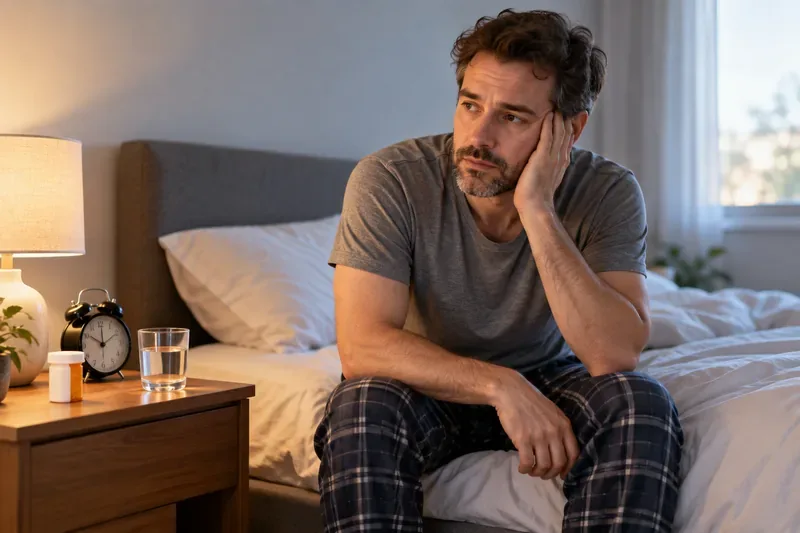
A cluster of mild symptoms can sometimes reflect overlapping sleep disruption, stress, and medication effects rather than one isolated men’s-health condition.
Why several mild symptoms can appear together
Urinary, sexual, sleep, and energy symptoms share multiple pathways. Poor sleep can increase fatigue and reduce concentration. Stress can disrupt sleep, increase body tension, and affect sexual interest or performance. Some prescription and over-the-counter medicines can change sexual function, urine flow, alertness, or nighttime urination. Meanwhile, waking repeatedly to urinate can itself fragment sleep, creating a cycle in which one mild problem makes another more noticeable.
For erectile dysfunction (ED), the National Institute of Diabetes and Digestive and Kidney Diseases (NIDDK) lists medical conditions, certain medicines, emotional factors such as anxiety and stress, and lifestyle behaviors as possible contributors. Its patient guidance, last reviewed in October 2024, also stresses that ED may be a sign of another health problem rather than a condition to self-diagnose in isolation. See the NIDDK overview of ED symptoms and causes.
Start with the easiest check: did sleep change first?
A few bad nights can make almost any mild symptom feel worse. More important, a persistent sleep problem can produce a recognizable cluster: daytime tiredness, difficulty focusing, reduced libido, and repeated awakenings. Obstructive sleep apnea deserves particular attention because the National Heart, Lung, and Blood Institute (NHLBI) lists sexual dysfunction or decreased libido and waking often at night to urinate among possible symptoms. Its sleep-apnea symptom page was last updated January 9, 2025. Review the NHLBI sleep apnea symptoms.
This does not mean nocturia—waking from sleep to urinate—automatically means sleep apnea. Nocturia can come from many causes, including fluid timing, bladder problems, prostate-related obstruction, medicines, diabetes, heart or kidney conditions, and sleep disorders. The practical clue is the pattern. Loud habitual snoring, witnessed pauses in breathing, gasping, morning headaches, or marked daytime sleepiness make a sleep discussion with a clinician more important.
What to try first
Keep a consistent sleep and wake time for one to two weeks.
Record how often you wake, and whether you wake because you need to urinate or notice the urge only after you are already awake.
Avoid using alcohol as a sleep aid; alcohol can worsen sleep quality and is also associated with sexual-function problems.
If the pattern improves when sleep improves, that is useful information, but it does not prove that sleep was the only cause.
Next, look at stress without assuming symptoms are “just psychological”
Stress has real physical effects. The National Institute of Mental Health (NIMH) describes stress as a physical or mental response to an external cause and notes that persistent anxiety can affect sleep and the reproductive system. NIMH recommends measures such as regular exercise, a consistent sleep routine, limiting excessive caffeine, and relaxation or mindfulness approaches. See the NIMH stress and anxiety fact sheet.
In men, stress may show up as trouble falling asleep, irritability, muscle tension, reduced desire, difficulty maintaining an erection, or increased awareness of urinary urgency. Performance anxiety can also amplify an occasional erection problem: one difficult experience creates worry about the next, and the worry itself can interfere with arousal.
The key distinction is duration and impact. A temporary cluster during a demanding work period may improve as the stressor settles. Symptoms that persist, worsen, or interfere with relationships, work, sleep, or daily function deserve medical attention even if stress clearly plays a role.
Then review medicines and supplements carefully
Medication effects are a common reason several mild symptoms can appear around the same time. NIDDK lists antidepressants, antihistamines, blood-pressure medicines, diuretics, sedatives, some pain relievers, and other drugs among medicines that may contribute to ED. Separately, NIDDK guidance on enlarged-prostate symptoms advises patients to tell a clinician about over-the-counter cold and cough medicines, decongestants, antihistamines, tranquilizers, antidepressants, and diuretics because some can worsen urinary symptoms. See the NIDDK benign prostatic hyperplasia guidance.
Antidepressants deserve special mention because U.S. Food and Drug Administration reviews have recognized sexual adverse effects with selective serotonin reuptake inhibitors (SSRIs) and serotonin-norepinephrine reuptake inhibitors (SNRIs), including decreased libido, erectile problems, and delayed or failed ejaculation in men.
Do not stop or reduce a prescribed medicine on your own. NIDDK specifically advises discussing a suspected medication effect with the prescribing clinician, who may consider timing, dose, alternatives, or whether another cause is more likely. Bring a complete list, including nonprescription cold medicines, sleep aids, antihistamines, supplements, and “male enhancement” products.
That last category needs caution. The FDA continues to warn that some products marketed for male sexual enhancement contain undeclared active ingredients. In June 2026, for example, the agency warned about a product found to contain unlisted yohimbine at potentially dangerous levels. The broader lesson is to avoid assuming that a “natural” sexual-health supplement is automatically safe. See the FDA’s June 10, 2026 safety notification.
Do not assume mild urinary symptoms equal an enlarged prostate
Weak stream, hesitancy, urgency, frequency, dribbling, or nocturia are called lower urinary tract symptoms (LUTS). The American Urological Association’s guideline on LUTS attributed to benign prostatic hyperplasia (BPH), published in 2021 and amended in 2023, emphasizes that symptoms can reflect complex interactions among the bladder, bladder neck, prostate, urethra, nervous system, and other medical conditions. In other words, symptom severity does not map perfectly to prostate size.
NIDDK makes the same practical point: a large prostate may cause few urinary symptoms, while a slightly enlarged prostate may cause more. Urinary symptoms can also come from bladder problems, urinary tract infections, prostatitis, medications, or other causes. This is why persistent urinary symptoms are better evaluated than guessed at.
When should testosterone enter the conversation?
Low energy, lower libido, and erection difficulty are sometimes attributed to low testosterone, but those symptoms are not specific. Sleep disorders, depression, chronic disease, medications, relationship stress, alcohol use, and other factors can produce similar complaints. MedlinePlus notes that obstructive sleep apnea can be associated with low testosterone levels, but a blood test and clinical evaluation are needed to interpret hormone symptoms appropriately. Its testosterone reference was reviewed January 25, 2026. See the MedlinePlus testosterone reference.
Do not start testosterone based only on fatigue or lower sexual interest. A clinician can decide whether testing is appropriate and how to interpret results in context.
A simple symptom log can make the next step clearer
For one to two weeks, track only a few variables so the record remains usable:
Bedtime, wake time, estimated sleep quality, and daytime sleepiness.
Nighttime bathroom trips and approximate evening fluid, caffeine, and alcohol intake.
Sexual symptoms: desire, erection reliability, ejaculation changes, and whether the problem is occasional or consistent.
Stress level and any major changes at work, home, or in a relationship.
All prescription medicines, over-the-counter products, and supplements, including the date each was started or changed.
This kind of timeline helps a clinician see whether symptoms began after a new medicine, during a period of poor sleep, or alongside a change in urinary habits. It can also reveal that symptoms are not moving together, which argues against forcing them into one explanation.
Red flags: symptoms that should not be watched at home
Mild symptoms can often be discussed at a routine appointment, but certain findings need prompt or emergency care. NIDDK advises immediate medical care for complete inability to urinate, painful urgent urination with fever and chills, blood in the urine, or severe lower-abdominal or urinary-tract pain. Acute urinary retention can be dangerous. See the NIDDK urinary retention guidance and NIDDK prostatitis guidance.
Sudden severe testicular pain is also an emergency because testicular torsion can cut off blood flow. MedlinePlus advises immediate medical attention for sudden, severe testicle pain, especially with swelling, nausea, or vomiting. See the MedlinePlus testicle-pain guidance.
Other reasons to arrange medical evaluation include a new testicular lump, persistent or worsening urinary symptoms, recurrent blood in urine or semen, persistent sexual dysfunction, significant unexplained fatigue, or symptoms that continue for weeks and affect daily life.
How to check whether your first steps are working
Do not judge success by whether every symptom disappears. A better result is a clearer pattern: fewer nighttime awakenings, more stable daytime energy, less urinary urgency, more consistent sexual function, or a recognizable relationship between symptoms and sleep, stress, alcohol, or medication timing.
If simple changes improve the pattern, keep the habits that helped and still mention recurrent symptoms at your next routine visit. If symptoms stay the same after a couple of weeks, recur repeatedly, or become more troublesome, move to the next step: a primary care clinician or urologist can review medications, check blood pressure and general health, consider urine or blood testing when indicated, and decide whether sleep evaluation or other testing is appropriate.
The goal is not to prove that sleep, stress, or a medicine is “the cause.” It is to avoid two common mistakes: ignoring a meaningful symptom because it seems mild, or assuming that several common symptoms must point to one serious diagnosis. A measured timeline, medication review, and attention to red flags usually provide a safer path forward.