Home
» Skin whitening
»
Why Skin-Lightening Products Can Cause Rebound Darkening or Uneven Tone
Why Skin-Lightening Products Can Cause Rebound Darkening or Uneven Tone
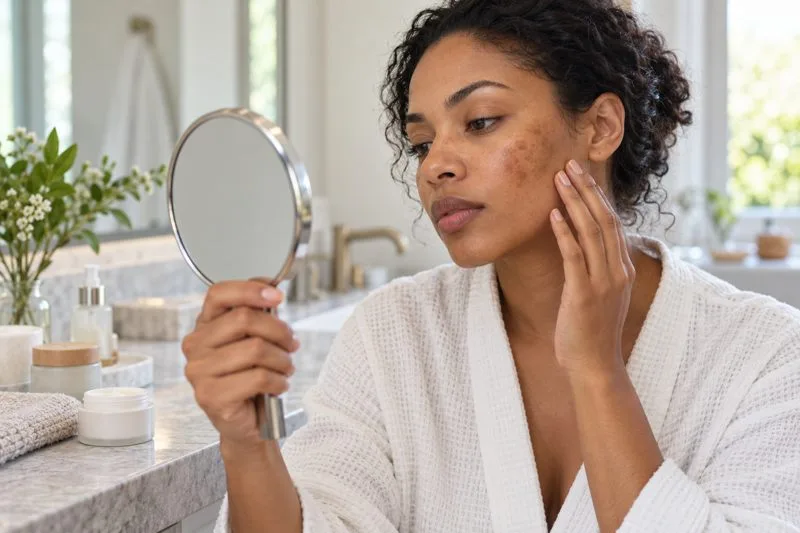
Illustrative example: Maya, a fictional adult, starts an over-the-counter “brightening” cream for brown patches on her cheeks. The patches fade a little, then look darker and more uneven after she spends time outdoors. She adds a scrub and a second serum, and her cheeks begin to sting. This imagined example is not a real patient story or a diagnosis. It shows why darkening after a skin-lightening product can have several explanations—and why adding more products may make the picture harder to understand.
A woman examines uneven tone in a mirror; brown marks may persist or deepen when the original trigger remains or the skin becomes irritated.
“Rebound” darkening can mean different things
People often use “rebound darkening” to describe any return of pigment after a lightening cream is stopped. It is not one diagnosis or a single proven reaction shared by all products. In many cases, the underlying pigment condition has not gone away: the cream temporarily reduced visible pigment, while sunlight, visible light, hormones, acne, eczema, or another trigger continued. Melasma, for example, can return and become more noticeable with sun exposure. A different possibility is that a product irritates or injures the skin, leading to new post-inflammatory hyperpigmentation (PIH)—dark marks left after inflammation heals.
So if Maya’s patches return, that does not automatically mean her skin has become “dependent” on a safe product. The product ingredients, how long and where it was used, the original cause, sun exposure, and any new irritation all matter. A clinician may need to examine the skin and review the product label before sorting these possibilities out.
Common reasons tone can look darker or less even
1. The original pigment trigger is still active
Skin-lightening ingredients can reduce pigment production or help fade existing discoloration, but they do not necessarily remove the reason pigment developed. Melasma is often persistent and may flare with sunlight, visible light, pregnancy, or other hormonal influences. Marks after acne, eczema, a burn, or friction can also remain while the underlying inflammation or repeated rubbing continues. When Maya returns to outdoor activities without reliable sun protection, older patches may darken again and new ones may appear.
The American Academy of Dermatology (AAD) notes that treating dark spots starts with identifying and addressing their cause, and that melasma can return. Its guidance recommends daily broad-spectrum, water-resistant SPF 30 or higher; for melasma and some darker skin tones, tinted sunscreen containing iron oxides can add protection from visible light. See the AAD’s melasma overview and self-care guidance.
2. Irritation can create new pigment
Some “brightening” routines combine several active ingredients, frequent exfoliation, or strong products. Burning, stinging, redness, scaling, or tenderness can signal irritation. Inflammation can stimulate pigment-making cells, and the resulting marks may be darker or more noticeable in medium-to-deep skin tones. AAD advises choosing gentle, fragrance-free skin care and stopping a product that burns or stings. Adding a scrub or extra serum—as Maya does in the example—can intensify irritation rather than speed fading.
Retinoids, exfoliating acids, and other active ingredients can be helpful for selected people when used appropriately, but tolerance and suitability vary. Avoid starting several actives at once or applying them more often than the label or clinician directs. If a prescription treatment is involved, ask the prescriber what to do about irritation before changing the regimen.
3. The product may contain a risky or undisclosed ingredient
Products marketed for skin lightening are not all regulated or formulated in the same way. Labels may be incomplete, counterfeit, or unclear, especially for products bought through informal online sellers or without a full ingredient list. In the United States, FDA warns consumers not to use over-the-counter skin-lightening products because some have contained mercury or hydroquinone; FDA says there are no FDA-approved or legally marketed OTC skin-lightening products. Its warning page describes reported rashes, facial swelling, and sometimes permanent skin discoloration with hydroquinone products, as well as possible kidney and nervous-system harm from mercury exposure. Rules differ by country, so check local health-authority advice. Read the current FDA consumer warning.
Some unregulated creams may also contain potent topical corticosteroids without clear labeling. Long, unsupervised use can cause fragile or thin skin, acne-like bumps, visible small blood vessels, or lasting color changes. A “fast result” or missing ingredient list is not proof that a product is unsafe, but it is a reason to avoid guessing about its contents and to seek qualified advice.
4. Less commonly, discoloration may be a treatment complication
Prolonged or excessive hydroquinone use has been associated with exogenous ochronosis, an uncommon condition that can cause blue-black or gray-blue discoloration. This is different from ordinary gradual return of brown patches. It is one reason hydroquinone should not be used indefinitely or casually without medical supervision. DermNet describes ochronosis following long-term hydroquinone use; its clinical page is available at DermNet’s ochronosis reference.
What Maya can do next
The safest next step depends on how her skin looks and what is in the cream. If it is an ordinary cosmetic and she develops burning, swelling, a rash, or worsening discoloration, she should stop the suspected irritating product and avoid adding new actives while the skin settles. She can keep the packaging and photograph the ingredient list, lot number, and affected areas in natural light. If it was prescribed, she should contact the prescriber before stopping or changing it, unless she is having a severe reaction that needs urgent care.
Use a simple routine: gentle cleanser, bland moisturizer, and sun protection. Avoid scrubbing, picking, bleaching agents, or unverified mixtures.
Protect exposed skin: use broad-spectrum SPF 30 or higher and reapply as directed on the product label, especially after swimming or sweating. For melasma, AAD recommends considering tinted sunscreen with iron oxide; hats and shade also help.
Check the product: keep the original container and ingredient list. Do not use an unlabeled product. FDA advises stopping products whose label lists mercury-related terms such as “mercurous chloride,” “calomel,” “mercuric,” “mercurio,” or “mercury.”
Arrange a dermatology review: seek guidance if discoloration keeps spreading, has an unusual blue-gray hue, does not improve, or the cause is unclear. Bring all creams, soaps, supplements, and a brief timeline of use.
When is it urgent?
Get prompt medical care for marked facial or eye swelling, blistering, severe pain, open sores, or a rapidly worsening rash. If a product may contain mercury, stop using it, wash exposed skin, keep it sealed away from children, and contact a health professional or local poison center for advice. In the United States, Poison Control is available at 1-800-222-1222. FDA notes that mercury exposure can affect the kidneys and nervous system; symptoms can include tremor, tingling or numbness, changes in vision or hearing, or memory and mood changes. These symptoms have many possible causes and do not establish mercury exposure on their own.
Arrange a routine medical assessment for persistent or changing patches, particularly if one spot is new, asymmetric, has an irregular border or multiple colors, bleeds, crusts, or grows. Pigment changes have many causes. A clinician can decide whether examination, dermoscopy, testing, or rarely a biopsy is appropriate. This article cannot diagnose a particular spot or determine what is in a product.
How to tell whether the plan is helping
For Maya, a useful check is not whether every mark disappears quickly. It is whether irritation stops, no new areas appear, existing patches gradually become less noticeable, and the routine is tolerable. Compare occasional photos taken in similar lighting rather than checking repeatedly in different mirrors or under different bulbs. Pigment can take months to fade, and deeper discoloration may take longer; faster is not always safer. If the patches worsen despite gentle care and sun protection, or the product caused a reaction, she should get an individualized assessment instead of escalating the lightening routine.
Sources and scope: This overview reflects public AAD, FDA, and DermNet guidance available on September 30, 2026. Product regulation and treatment choices vary by country and by the cause of the discoloration. The example is fictional; the information is general education, not an individual diagnosis or treatment plan.