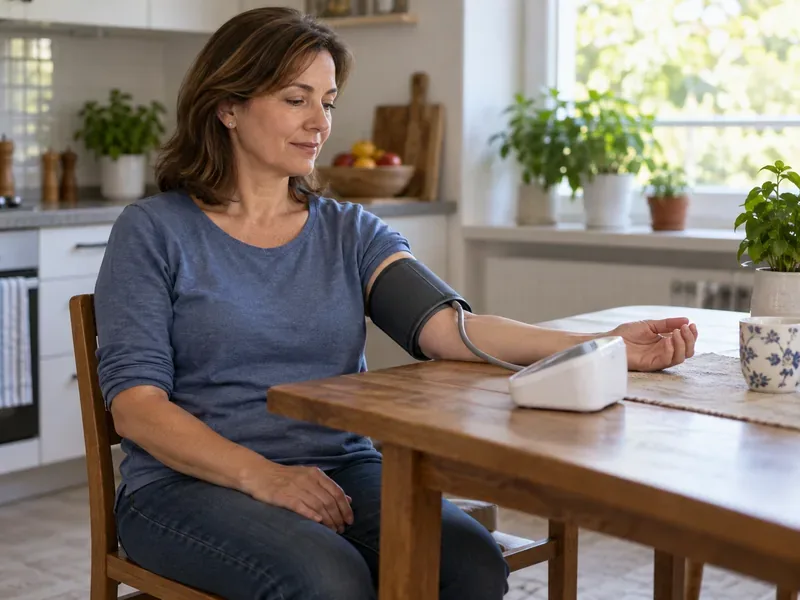
If your home blood pressure readings differ between your arms, record the numbers with the arm, order, time, and measurement conditions. A difference from one session may reflect normal variation or measurement technique; a repeatable difference is useful information for your clinician. This five-step guide is for adults who monitor blood pressure at home. It helps you build a clear record, not diagnose the cause or change treatment. Follow any arm-specific instructions from your care team.
Prerequisites
- Equipment: A validated automatic upper-arm monitor with a cuff sized for your arm, plus a paper or digital log. Check cuff size against the manufacturer’s range.
- Time: About 15–20 minutes for an initial comparison, including quiet rest and repeat measurements. This is an estimate, not a tested duration.
- Difficulty: Easy.
Step 1: Set up a consistent measurement session
Choose a quiet time and sit with your back supported, feet flat on the floor, and legs uncrossed. Avoid caffeine, smoking, and exercise for at least 30 minutes beforehand, empty your bladder, and rest quietly for five minutes. Use the same monitor and comparable conditions when you repeat the comparison. Write down anything that could affect the reading, such as recent activity or feeling unwell.
Step 2: Check the cuff and position
Use the cuff on bare skin, following the monitor’s instructions for placement. The cuff must fit the arm’s circumference; a cuff that is too small may read high, while one that is too large may read low. Support the arm so the middle of the cuff is near heart level. If either arm has a fistula, recent surgery, an injury, or another restriction, ask your care team which arm is appropriate before measuring it.
Step 3: Record the first arm’s readings
Measure the first arm, then take a second reading on that same arm one minute later. Record both readings as systolic over diastolic pressure in mm Hg (for example, 132/78), the pulse if shown, the arm used, date and time, and which reading came first. Do not choose just the lower result or erase an unexpected reading. Keeping both measurements shows how much the values varied within that arm.
Step 4: Measure the other arm and note the order
After the first arm’s pair, measure the other arm using the same posture and cuff. Record two readings one minute apart and label them clearly as right or left. Because sequential readings can vary as you settle into the session, order matters: note which arm was measured first and how long you waited before switching. If the difference looks notable, repeat the comparison in another session rather than repeatedly cycling between arms in one sitting.
Step 5: Summarize the pattern for your clinician
For each session, calculate the systolic difference by subtracting the lower top number from the higher top number, and identify which arm had the higher result. For example, if the right-arm reading is 136/82 and the left-arm reading is 128/80, the systolic difference is 8 mm Hg, with the right arm higher. Record the original numbers as well as the difference; do not average readings across arms or use this example as a personal target.
Bring the log and monitor to an appointment or send the record through your care team’s approved method. Include your device model, cuff size, any irregular-heartbeat indicator, and relevant notes such as a missed rest period or recent activity. The 2024 European Society of Cardiology guideline says a systolic difference greater than 10 mm Hg should be checked for consistency; after a confirmed difference, subsequent measurements are taken on the higher-reading arm. That is clinical guidance, not a reason to diagnose yourself. Ask your own clinician which arm to use for your ongoing home log.
Troubleshooting
- The difference changes direction or disappears: Check that the cuff fits and each arm is supported at heart level. Keep the measurement order in your notes and repeat on another day under similar conditions. A single pair cannot establish a persistent pattern.
- One side’s results are consistently much higher: Share the full paired readings and dates with your clinician. Guidelines use different thresholds: NICE advises repeating a difference over 15 mm Hg during assessment, while the 2024 ESC guideline uses a systolic difference over 10 mm Hg. Your clinician can apply the appropriate guidance and decide whether evaluation is needed.
- The readings seem implausible or the monitor flags an error: Recheck cuff size, placement, tubing, posture, and batteries; remain still and quiet during measurement. Bring the monitor to an appointment so your healthcare professional can review technique and compare it with office equipment.
Frequently asked questions
Is it normal for blood pressure to differ between arms?
Some variation is common, and a small difference on one occasion does not by itself identify a health problem. The useful question is whether a difference repeats when technique is consistent. Record it and ask your clinician how to interpret your pattern.
Which arm should I use for my regular home readings?
Ask your care team, especially if repeated comparisons show one arm running higher. The 2024 ESC guideline recommends using the higher-reading arm after a systolic difference greater than 10 mm Hg is confirmed. A clinician can account for your health history and any arm-specific restrictions.
When should a high reading prompt urgent action?
If a reading is higher than 180/120 mm Hg, wait at least one minute and measure again. If it remains that high, contact a healthcare professional immediately. Call 911 for a reading above 180/120 accompanied by chest pain, shortness of breath, back pain, numbness, weakness, vision change, or difficulty speaking. Do not delay emergency care to keep comparing arms.