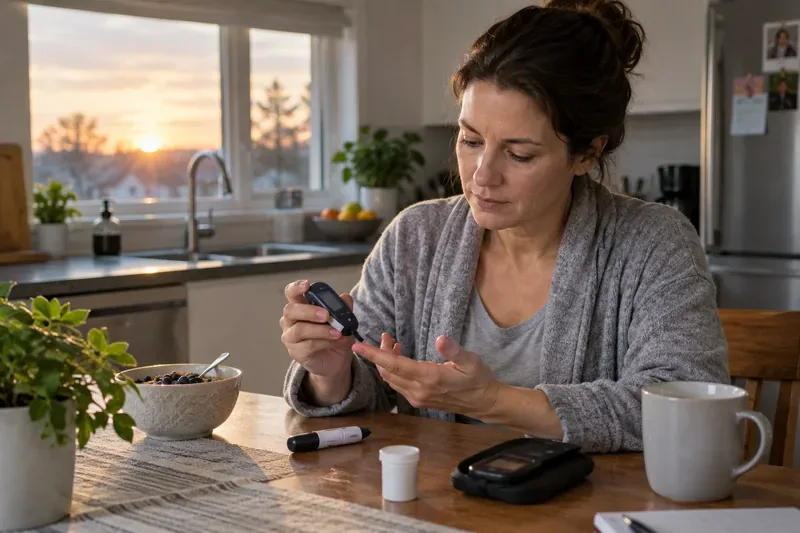
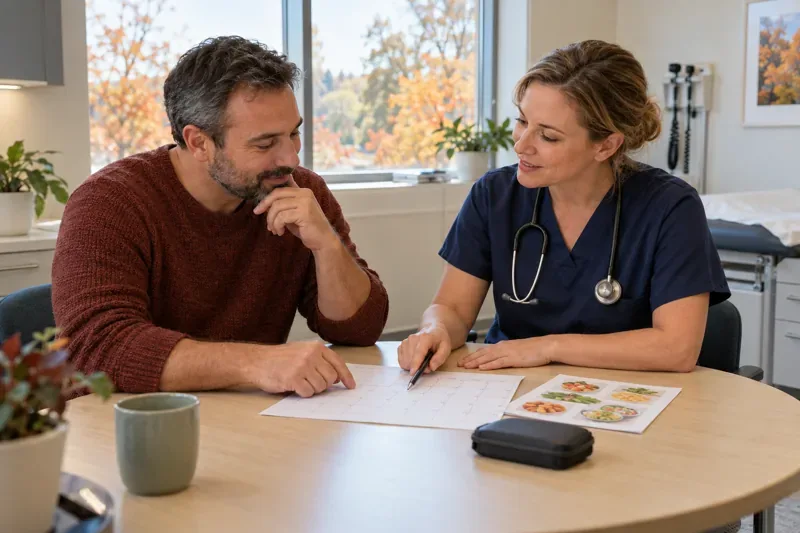
To find out whether high morning glucose might fit a dawn-related pattern, keep a short, consistent record of your bedtime reading, overnight glucose trend when available, wake-up reading, and relevant context. This guide is for people who already monitor glucose and want a useful record for their diabetes care team. A log can reveal timing; it cannot diagnose the cause or tell you to change treatment.
Preparation
| What to have | Details |
|---|---|
| Glucose monitoring method | Your usual blood glucose meter or continuous glucose monitor (CGM), plus its app or receiver if you use one. |
| Recording tool | Paper, notes app, or a spreadsheet with date, time, readings, and context. |
| Care plan | Your individualized glucose targets, instructions for low or high readings, and your clinic’s contact method. |
| Time and difficulty | About 5–10 minutes a day to review and record, over several typical nights; easy. This is a planning estimate, not a required testing schedule. |
How to log morning glucose patterns in 7 steps
Step 1: Set the question with your care team
Write down what you have noticed, such as “my readings are often higher when I wake up.” Ask your clinician what counts as high for you, how long to track, and which results should prompt a call. Targets and monitoring schedules vary. Do not adopt a target from someone else or change a medicine, dose, timing, meal plan, or pump setting based on this guide.
Step 2: Choose one reliable record
Use the meter or CGM you normally use, following its instructions. A CGM estimates glucose from fluid under the skin and records a trend through the night; it is not the same measurement as a finger-stick blood glucose test. Device readings can differ, and some situations may call for a meter check under your device instructions or care plan. Keep the source of each number clear: mark “CGM” or “meter.”
Step 3: Record your bedtime baseline
Before bed, note the time and reading if it is part of your usual care routine. Add the time and general description of your last meal or snack, any activity later in the day, alcohol if relevant, illness or unusual stress, and the medicines you took and their prescribed timing. Record what happened; do not change your routine just to produce a particular reading.
Step 4: Capture the overnight trend safely
If you already use a CGM, save or review its overnight graph according to the app or receiver instructions. Note whether the trace was broadly steady, rose, fell, or had gaps, and when a notable change appeared. You usually do not need to wake yourself to create a reading if your CGM captures the night. If you do not use a CGM, ask your care team whether and when an overnight meter check is appropriate for you. Do not set an alarm for a middle-of-the-night test unless they recommend it.
Step 5: Note the wake-up reading and timing
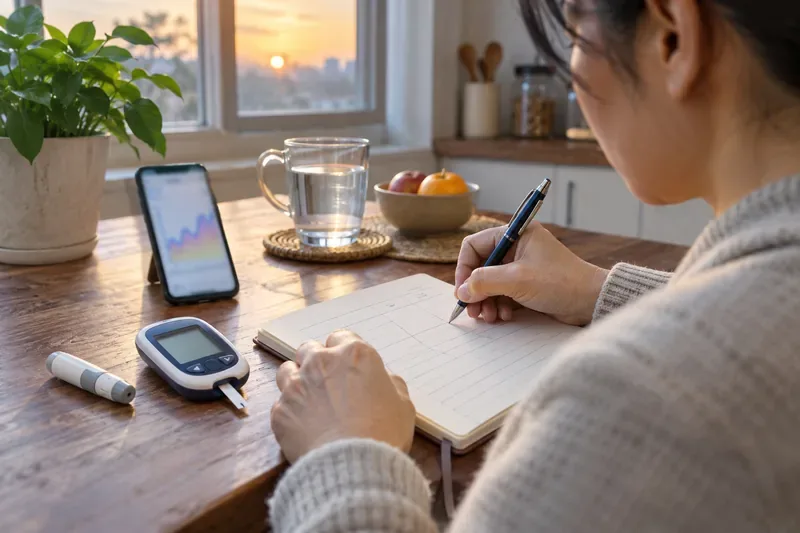
Record the time you woke and the reading, identifying whether it came from a CGM or meter. When it fits your prescribed routine, note whether the reading was taken before food or other morning activity. Do not delay a prescribed medicine or needed treatment to make the log neater. If symptoms do not match a CGM value, follow your device instructions and personal care plan for confirming the reading.
Step 6: Repeat on typical nights and mark exceptions
Continue for several nights that reflect your usual routine, or for the period your clinician requests. There is no universal number of nights that proves dawn phenomenon. Mark unusual circumstances—late meal, missed or delayed medicine, strenuous evening activity, poor sleep, stress, or illness—rather than treating those nights as ordinary. Keep the exact time shown by your device; note a time-zone or clock change if it affects the record.
Step 7: Summarize the pattern for your appointment
Bring the log or share the CGM report through the method your clinic uses. A brief summary is enough: how often the morning reading was above your personal range, whether the bedtime value was already elevated, and whether the overnight trace rose or fell. For example, “On several usual nights, bedtime readings were within my care-plan range; the CGM trace began rising before I woke.” That describes a pattern for discussion; it does not establish a diagnosis. Ask whether the pattern could fit an early-morning rise, an elevated bedtime level that continued overnight, medication coverage or timing, or another factor.
Troubleshooting
The CGM and meter do not match
Do not average the numbers or assume one is automatically correct. CGMs measure interstitial glucose and may lag behind blood glucose as levels change. Check the CGM manufacturer’s instructions and your clinician’s plan for when to confirm with a meter, especially if symptoms and sensor readings disagree.
You missed a bedtime or overnight entry
Leave it blank or mark it “not measured.” Do not estimate a value. Continue your normal monitoring routine and record the actual times; a complete-looking but guessed log is less useful than an honest record with gaps.
You see a low, very high value, or feel unwell
Handle the situation using your individualized low-glucose, high-glucose, or sick-day instructions; do not wait to finish the tracking period. Many people use below 70 mg/dL as a low-glucose threshold, but your personal instructions may differ. If you have very high glucose with vomiting, trouble breathing, fruity-smelling breath, or other possible signs of diabetic ketoacidosis, follow your emergency plan and seek urgent medical help. In the U.S., CDC advises emergency care for trouble breathing, fruity breath, vomiting with inability to keep fluids down, or other serious DKA signs. Review CDC guidance on diabetic ketoacidosis.
Frequently asked questions
Does one high fasting reading mean I have the dawn phenomenon?
No. A single result does not show when glucose rose or why. Bedtime and overnight information, repeated in context, can help your care team assess possible explanations.
Should I wake up at 3 a.m. to check my glucose?
Not automatically. If you use a CGM, its overnight trace may provide the timing without waking you. If you use a meter, ask your clinician whether an overnight check is needed and what time is appropriate.
How many mornings should I track?
There is no single required count for everyone. Record several representative nights if that is safe and manageable, and follow the timeframe your care team gives you. Contact them sooner if readings or symptoms concern you.