Home
» Nutrition
»
How to Compare Protein, Fiber and Added Sugar Without Falling for Package Claims
How to Compare Protein, Fiber and Added Sugar Without Falling for Package Claims
Front-of-package language can make two foods look easier to compare than they really are. “High protein,” “good source of fiber,” “no added sugar,” “healthy,” and similar claims can be useful clues, but they are not substitutes for the Nutrition Facts panel, serving size, ingredient list, or your own health needs. The most reliable approach is to compare like with like: first make sure the serving sizes are comparable, then read protein and dietary fiber as amounts to seek, added sugar as an amount to limit, and finally check whether the overall food still makes sense in your eating pattern.
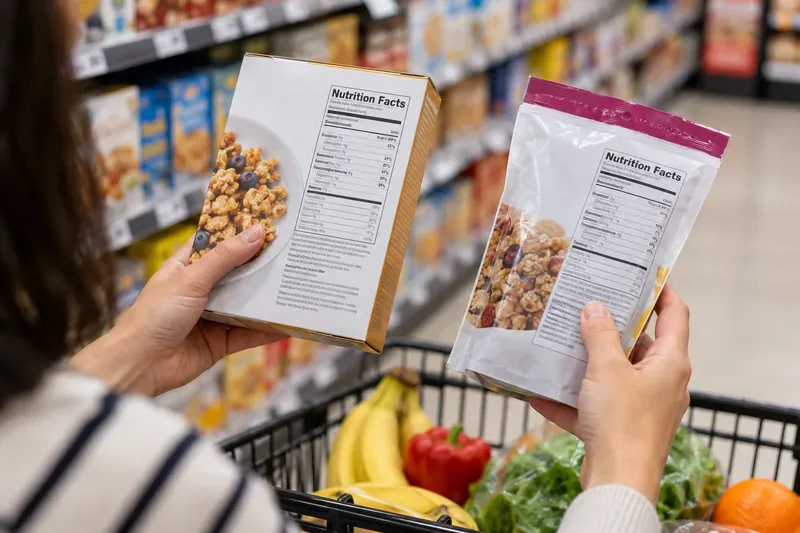
A shopper compares two packaged foods by looking beyond the front of the package and checking their Nutrition Facts panels side by side.
What should you check before comparing the nutrient numbers?
Start with the serving size. A product that lists 8 grams of protein per serving may not be higher in protein than one listing 6 grams if the first serving is much larger. The U.S. Food and Drug Administration (FDA) explains that serving sizes on Nutrition Facts labels are based on amounts people typically consume, not on how much a person is necessarily supposed to eat. That means serving size is mainly the denominator for the rest of the label.
If two products use the same serving size, a direct comparison is straightforward. If they do not, normalize them before deciding. For example, if Product A lists 6 grams of fiber per 60-gram serving and Product B lists 4 grams per 40-gram serving, both provide 10 grams of fiber per 100 grams of food. Looking only at “6 grams versus 4 grams” would make Product A appear better when their fiber density is actually the same.
For foods usually eaten in similar amounts, you can compare per serving after adjusting for portion differences. For very different foods, such as yogurt and granola, it is more useful to ask what role each food plays in the meal rather than forcing a single winner.
Should protein be the first number you prioritize?
Not automatically. Protein matters, but a large number on the front of a package can distract from other parts of the food. The current Dietary Guidelines for Americans, 2025–2030, released in January 2026, emphasize nutrient-dense protein foods from both animal and plant sources as part of an overall eating pattern. The guidance gives a general protein target of 1.2–1.6 grams per kilogram of body weight per day, adjusted for individual calorie needs. That is a daily-pattern recommendation, not a rule that every snack or packaged food must be protein-heavy.
On the Nutrition Facts label, the gram amount of protein is required, but the % Daily Value for protein is not always shown. FDA guidance states that protein %DV is generally required when a protein claim is made or for products intended for young children. This is one reason comparing grams of protein per comparable amount of food is often more practical than looking for a protein %DV.
Package claims such as “high in protein” are regulated nutrient-content claims. Under FDA rules, terms such as “high,” “rich in,” or “excellent source of” generally mean a food provides at least 20% of the Daily Value for the nutrient per reference amount customarily consumed, while “good source” generally means 10% to 19%. Even so, the claim describes one nutrient. It does not mean the food is automatically low in added sugar, high in fiber, or a better choice for every person.
How much weight should you give dietary fiber?
Fiber is often a useful quality marker, especially when comparing grain products, cereals, breads, snack bars, and similar foods. The FDA Daily Value for dietary fiber is 28 grams on a 2,000-calorie diet. As a quick label-reading tool, FDA guidance commonly treats 5% DV or less as low and 20% DV or more as high for a nutrient. A food with 20% DV of fiber therefore makes a meaningful contribution to the daily reference amount.
Still, fiber claims need context. Added isolated or synthetic fibers can count as dietary fiber on the label only when they meet FDA requirements, and a food with a fiber claim may still contain substantial added sugar or calories. Check the ingredient list and the rest of the panel rather than assuming “high fiber” means the whole product is minimally processed or nutritionally ideal.
If you are increasing fiber intake, do it in a way your digestive system tolerates. The National Institute of Diabetes and Digestive and Kidney Diseases notes that increasing fiber too quickly can cause gas and bloating in some people and advises gradual increases in certain gastrointestinal contexts. See NIDDK guidance on fiber and digestive symptoms.
Why is added sugar more useful than total sugar for this comparison?
Total Sugars combines naturally occurring sugars and added sugars. Added Sugars separates the sugars introduced during processing or preparation, including sugars from syrups, honey, and certain concentrated fruit or vegetable juices. The FDA currently sets the Daily Value for added sugars at 50 grams per day for a 2,000-calorie diet. The agency explains the distinction in Added Sugars on the Nutrition Facts Label.
This distinction prevents a common comparison error. Plain milk and fruit can contain total sugar without containing added sugar. A sweetened yogurt may have both naturally occurring lactose and added sweeteners. If you compare only Total Sugars, you may penalize foods for sugars that naturally occur in otherwise nutrient-dense foods.
The current federal dietary guidance places strong emphasis on limiting added sugars and highly processed foods. The practical label question is therefore not “Does this food contain any sugar?” but “How much added sugar does this serving contribute, and what else does the food provide?”
Can “no added sugar” still be misleading?
It can be misunderstood even when the claim is technically accurate. “No added sugar” does not mean “sugar free,” “low calorie,” “high fiber,” or “high protein.” A product made from dried fruit, for example, can have substantial total sugar with no added sugar. Likewise, a product with no added sugar can still be low in fiber or contain ingredients that do not fit your goals.
The same principle applies to “healthy.” The FDA updated the criteria for use of the voluntary “healthy” nutrient-content claim. Under the updated rule, qualifying foods must contain a meaningful amount of a recommended food group and stay within limits for added sugars, saturated fat, and sodium. The criteria took effect in 2025. Details are available from the FDA at Use of the “Healthy” Claim on Food Labeling.
A “healthy” claim can therefore carry more regulatory meaning than a vague wellness-style phrase, but it still does not tell you whether the product is the best fit for a particular meal, budget, allergy, medical condition, or personal preference.
What is the fastest fair comparison at the store?
For two similar packaged foods, use this sequence:
Match the serving basis. If serving sizes differ, compare the nutrients per equal weight, equal volume, or another realistic common amount.
Compare protein grams. Higher can be useful when protein is a goal, but do not treat protein alone as a quality score.
Compare fiber grams and %DV. More fiber is often favorable when the foods are otherwise similar and the increase is comfortable for your digestive system.
Compare Added Sugars, not just Total Sugars. Lower added sugar is usually preferable when two products serve the same purpose and offer similar nutrition otherwise.
Scan the full panel and ingredient list. Calories, saturated fat, sodium, allergens, whole-food ingredients, and portion size may change the decision.
Consider this hypothetical comparison of two cereals with the same 50-gram serving size. Cereal A has 8 grams of protein, 2 grams of fiber, and 10 grams of added sugar. Cereal B has 6 grams of protein, 7 grams of fiber, and 2 grams of added sugar. If you looked only at protein, A would win. If your priority is a more fiber-rich cereal with less added sugar, B may be the stronger fit. The point is not that fiber always outranks protein; it is that one front-of-pack number should not erase the rest of the label.
What package claims deserve a second look?
Claim
What it can tell you
What it does not tell you
“High protein”
The product meets criteria for a high-level protein claim.
Whether it is high in fiber, low in added sugar, or right for your medical needs.
“Good source of fiber”
The product provides a meaningful amount of fiber under FDA claim rules.
Whether the food is low in calories, sodium, or added sugar.
“No added sugar”
No sugars were added in the way covered by the claim.
Whether total sugar is low or the product is sugar free.
“Healthy”
The food must meet FDA criteria tied to food groups and limits for certain nutrients.
Whether it is ideal for every person or every eating pattern.
When should general label advice give way to individualized guidance?
Package-label comparison is useful for everyday shopping, but it is not a diagnostic tool and cannot replace a medical nutrition plan. Personalized advice becomes especially important if you have been told to follow a specific protein, carbohydrate, potassium, phosphorus, sodium, or fiber target; if you are pregnant or breastfeeding; if you are feeding a young child with specific growth or nutrition concerns; or if food choices are being used to manage a diagnosed condition.
Protein is a clear example. NIDDK notes that some people with chronic kidney disease may need to adjust protein intake, while people receiving dialysis may have different protein needs. That means a generic “more protein is better” message can be inappropriate in some medical contexts. See NIDDK guidance for adults with chronic kidney disease.
Seek timely professional advice rather than continuing to experiment with diet alone if you develop persistent or severe gastrointestinal symptoms, unexplained weight loss, repeated vomiting, blood in stool, signs of dehydration, or symptoms that interfere with eating or daily function. Those findings have many possible causes and cannot be explained from a food label.
A simple rule that prevents most package-claim mistakes
Use the front of the package to decide what to investigate, not what to believe. Then verify the serving size, protein, fiber, added sugar, and the rest of the Nutrition Facts panel. If serving sizes differ, normalize them. If one nutrient looks impressive, check what the product gives up elsewhere. And if your diet has been individualized for a medical reason, use that plan rather than a generic package claim as your decision rule.
This method does not produce one universally “best” food. It produces a fairer comparison—one that is harder to distort with oversized servings, selective claims, or attention-grabbing numbers.